
If you’ve been quietly working out how to make my business run without me — and getting nowhere — you’re not the only one. Most owners I work with have been trying to crack this for years. Let me show you what they’re missing.
When was the last time you took a full week off and didn’t check your inbox once?
Not “off but I just had to deal with one thing.” Not “off but I jumped on a Zoom on the Wednesday.” Off off.
If you’re struggling to remember, you’re in the majority. Most owners I work with haven’t had a proper week off in three or four years. Some haven’t had one since they started the business.
And here’s the bit that stings a little. You know your business is too dependent on you. You’ve thought about fixing it. You’ve maybe even hired people to fix it. But every time you peek at it from the outside, you spot something only you can do — and you climb back in.
That’s not pride. It’s not weakness either. It’s the trap I see eat owners alive: the more competent you are, the more your business shapes itself around your specific brain. And the harder it becomes to leave.
This week’s podcast guest, James Ashford, found his way out of it.
A few years ago, James sold a business to Sage for an eight-figure sum. He owned 90% of it. He’d taken zero outside investment. He’d built it from nothing to a £1.5m turnover acquisition in roughly five years. He still has the original receipt from the day he closed the deal.
You probably know the kind of story by now. They’re a dime a dozen on LinkedIn.
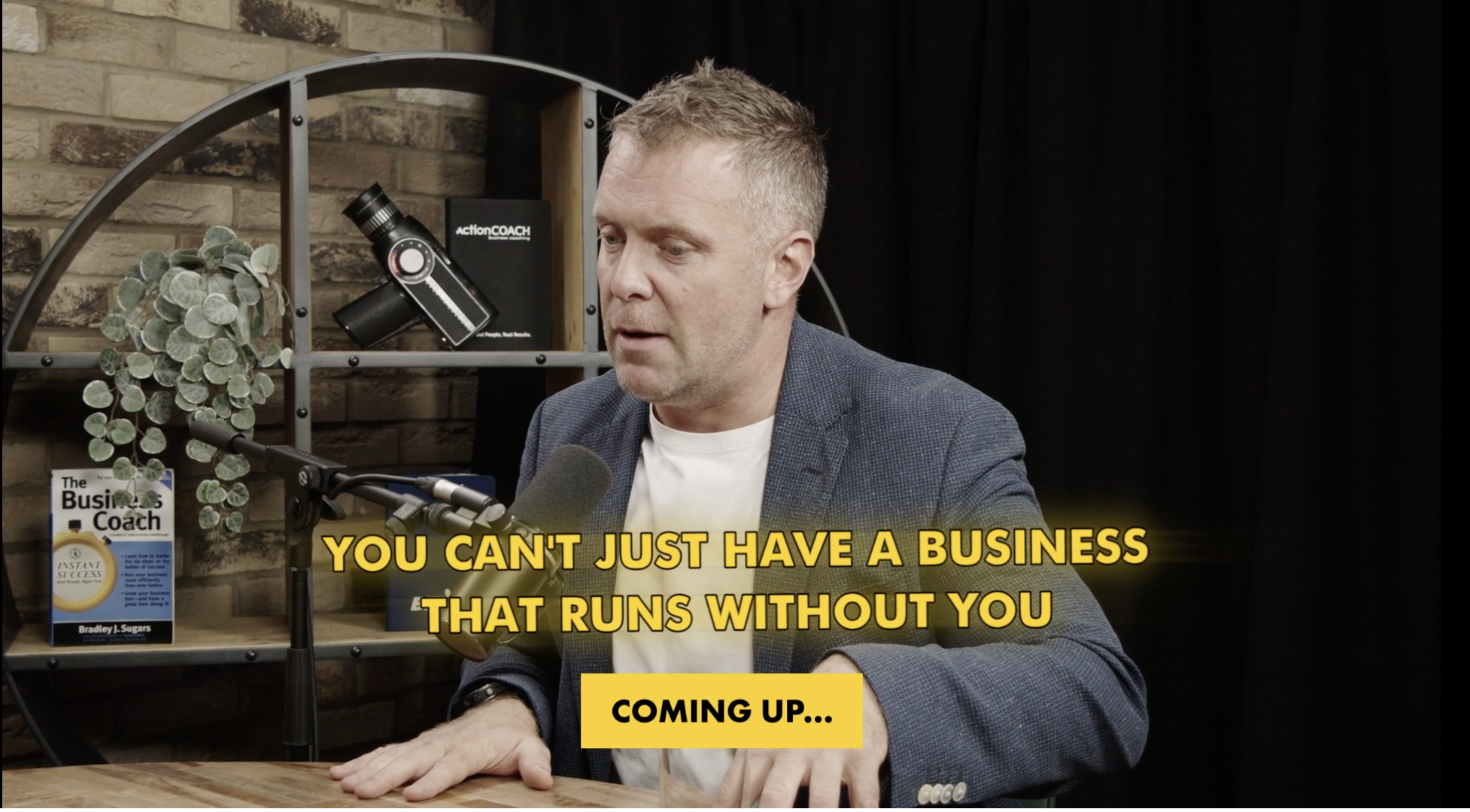
What’s different about James’s story is the line he delivered about ten minutes into our podcast conversation. He’s been describing how acquirers run their due diligence, and he says:
‘You can’t just have a business that runs without you. You have to have a business that grows without you.’
Stop and read it again.
This is why how to make my business run without me is the wrong question. The right question is how to make my business grow without me. Two completely different bars.
Most owners I work with believe the goal is a business that runs without them. They’ve heard it for years, the famous Michael Gerber line ‘work on the business, not in it.’ They take it as gospel. So they hire managers. They build systems. They take a holiday and the place doesn’t catch fire. They breathe out.
And then they discover the business is still worth less than they expected. Because acquirers don’t pay for businesses that simply tick along without their owner. They pay for businesses that keep growing without their owner.
That’s a different bar. And almost nobody clears it.
The acquirer’s actual test
James told a story about the final stretch of his Sage acquisition. The deal took roughly nine months from preparation to close. Three months getting ready, six months from going to market to ink dry. In the last few weeks of the process, his attention was almost entirely on the acquirer. He was preparing data rooms, jumping on calls, answering due diligence questions.
He had basically zero capacity left for the business itself.
That last month showed up in two ways. First, the business needed to keep operating cleanly while the new owner peered into every corner. It did. But the second test was the one that mattered. The business kept growing through that month. New customers, expanding revenue, the same trajectory it had been on the previous quarter. Without his hands on it.
That is what an acquirer is actually buying. Not the absence of you. The continuation of growth without you.
How to make my business run without me — where most owners stop
In the businesses I coach, owners stop at one of three places, and each one caps their exit value.
The first stop is ‘I’m still doing all the work.’ That one is obvious. The business is them. There’s no team. Their bandwidth is the ceiling. Exit value: zero, because there is no business, just a job that they own.
The second stop is ‘the team does the work, but I still make all the decisions.’ This is the most common one. The owner has built a team. Operations run without them. But every decision over a certain size flows back to them. The pricing call. The team performance call. The new market call. The hire. The fire. They’ve become the brain stem of the business. Operations work, but thinking is centralised.
This is where most businesses get to and stop. They feel grown-up. They aren’t. Exit value: low, because what the buyer would inherit is a brain stem they’d have to replace.
The third stop is ‘I’ve appointed a managing director and the business runs without me.’ Better. Operations work, decisions flow through the MD, the owner can take a month off. This is where most owners think the work ends. James Ashford says it’s where the actual work starts.
Because a business with an MD still doesn’t necessarily grow. It just runs. The growth engine, bringing in new customers, expanding to new markets, recruiting new senior people, deciding the next product, often still depends heavily on the owner’s energy and ideas.
A business that grows without you has the next layer in place. The growth function isn’t you any more.
The diamond mine principle
James has a phrase he uses with clients. He calls it the diamond mine mindset.
The diamonds are already in your business. You don’t need to find better clients. You need to create them out of the average ones. You don’t need to find better staff. You need to develop them. You don’t need a better product. You need to systemise the one you have until any junior employee can deliver it as well as your best one.
He puts this very specifically. ‘Great clients don’t exist,’ he told me. ‘Great clients are created.’ Same for staff. Same for systems. The owner who finally gets a business that grows without them is the one who has stopped looking outside for the missing piece and started building everything they need from the team they already have.
That includes the next leader. Including, eventually, the leader who replaces them.
The playbook trap most owners fall into
When James started writing playbooks for every part of his business, the sales calls, the email templates, the way someone licked a stamp before sticking it on an envelope (yes, really), people in his network warned him he’d turn his team into robots.
The opposite happened. The playbook freed his team to be creative inside the work because they didn’t have to invent the basics. Every junior staff member could deliver the most complex customer process in under 15 minutes. That single design constraint, he says, is what beat a US-funded competitor with $25m of funding and a 7-year head start.
A playbook isn’t a script. It’s a runway. When the team isn’t reinventing the basics each time, they have the bandwidth to actually serve the customer.
What to do this week
Pick one thing in your business that still requires you.
Not ‘could be done by someone else if I trained them.’ Something you genuinely do, today, that nobody else does.
Now answer two questions about it.
One: if you weren’t in the business next week, would this thing still happen?
Two: would it still grow next week?
The first question is the ‘runs without me’ test. The second is the ‘grows without me’ test. Most owners can pass the first if they squint. Almost nobody passes the second.
If you can’t pass both, that’s the next decision you need to systemise, document, and pass to someone else. With a check-in date in the diary. And a refusal to take it back the moment they get it wrong.
Repeat for the next decision. And the next.
That’s how an eight-figure exit gets built. One decision at a time, handed over.
Knowing how to make my business run without me is half the equation. The other half — building it so it grows without you — is harder. Most owners never even start it. (If you’d like a structured way to map out which decisions are still tying you in, my Upgrade Audit walks you through it in one focused session.)
James Ashford is the guest on this week’s ActionCOACH Podcast.
🎵 Spotify: https://open.spotify.com/episode/6p6MjKqyVPrIGDHX5gC3do?si=XB4aY2XZQUKIvDr4acvtdQ
🎙️ Apple: https://podcasts.apple.com/gb/podcast/the-actioncoach-podcast/id1683102859?i=1000744246971
Want a 5-minute honest read on which decisions in your business are leaking value because they still depend on you? Take the Score Card Quiz.