
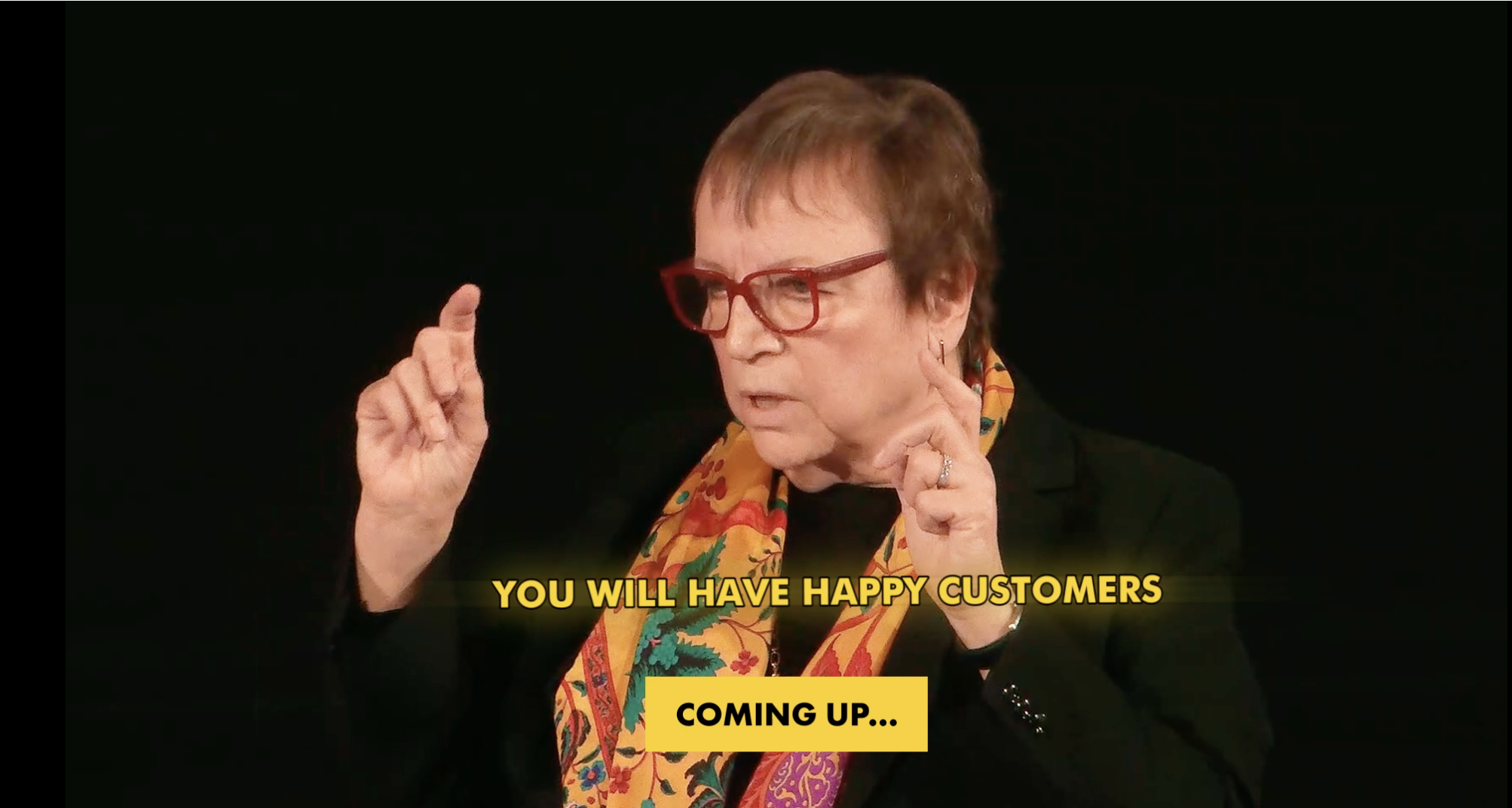
If you’ve ever Googled how to have difficult conversations as a business owner, you’ve probably found a thousand pieces of generic advice that don’t quite help. This one’s different. It starts with a reframe from one of the most senior women in global banking.
Is there a conversation you’ve been rehearsing in your head for weeks?
The one you keep replaying in the shower. The one you’ve drafted three versions of and not sent any. The one you mentally avoid every time you see that person’s name pop up in your calendar.
Most owners I work with are carrying at least two of these at any one time. The pricing chat with the long-term client who’s quietly underpaying you. The performance conversation that should have happened in March. The exit chat with the team member who isn’t a fit. The supplier who keeps letting you down.
You haven’t avoided it because you’re weak. You’ve avoided it because you’ve labelled it as “difficult.” And once your brain has put that label on it, your nervous system treats it like a threat — and the body is brilliant at avoiding threats.
This week’s podcast guest, Irene Dorner, has lived inside that pattern at a scale most of us can’t imagine.
Irene has spent more time learning how to have difficult conversations as a business owner than most leaders we coach. At a scale most of us can’t imagine.
Irene became the first female CEO of HSBC USA in 2010. In her first two weeks she discovered two things she hadn’t been told before she signed the contract. The first was that the bank she’d just taken over had just lost three billion dollars on its sub-prime mortgage book. The second was that the United States Department of Justice was running an active money-laundering investigation against it.
She had been sent in as the fixer.
She spent the next six months drowning in spreadsheets. New processes. New controls. New systems. She was attacking it as a plumbing problem, because that’s what former trading-floor executives do. You see something broken in the pipes, you replace the pipes.
Six months in, she realised the pipes were fine. The processes were textbook. The problem was the people. Nobody owned anything. The same problem kept reappearing in slightly different places because the behaviour underneath it hadn’t changed.
‘You can’t fix a culture as fast as you can fix a process,’ she told James on this week’s podcast.
That’s the line. And it’s the reason most business owners I work with are stuck.
The thing you keep ‘fixing’
Think about the recurring problem in your business right now. The one you keep introducing new processes to solve. The team meetings that aren’t working, so you’ve added a new agenda template. The hires who don’t last, so you’ve redesigned the interview process. The clients who slip through, so you’ve built a new follow-up sequence.
You’re rewriting the pipes. The leak is somewhere else.
The leak is almost always behavioural. Someone in your business has quietly decided that a rule doesn’t apply to them. Someone has worked out that nobody actually checks. Someone has assumed that ‘we’ve never had a problem before, so I’d just turn it off.’
That last line is real. Years into the HSBC investigation, Irene was at a New York cocktail party when a man in his late twenties sidled up and confessed. The bank had an algorithm designed to catch illicit payments. It took a few minutes a day to run. He had been told the bank ‘had never had a problem before.’ So he had just turned it off.
A few hundred million dollars of dirty money walked through the gate he had left open.
He wasn’t a criminal. He was a well-meaning young man with a sensible piece of common sense that turned out to be catastrophic. Nobody had told him why his bit mattered. Nobody had drawn the line of sight for him, from his desk to the front page of the Wall Street Journal.
That is a small business problem too. Your office manager has quietly stopped sending one of the forms because the bookkeeper said it ‘wasn’t really needed.’ Your salesperson has stopped logging the second touch in the CRM because ‘everyone knows who they’re talking to.’ Your operations lead has stopped checking the second invoice because ‘they’ve never been wrong.’ Each of those decisions feels sensible to the person making it. Each of them is one shortcut away from a real problem.
The fix isn’t another process. The fix is making sure every single person can answer the question ‘why does my bit matter.’
How to have difficult conversations as a business owner — the reframe that changes everything
The second great Dorner gift is how she handles the moments when behaviour does break down.
She doesn’t call them difficult conversations. She calls them important ones.
‘The minute you say difficult, it’s gone difficult in my head,’ she told James.
This sounds like semantics. It is the opposite of semantics. Try it for a week. The word actually changes what your nervous system does as you walk into the meeting.
When you call something a ‘difficult conversation,’ you’ve already loaded it with dread. Your body knows you’re walking into a confrontation. Your face shows it before you sit down. You enter pre-defensive. The other person reads it. They go pre-defensive too. Now you’re not having a conversation. You’re having a stand-off.
When you call it an ‘important conversation,’ you’ve shifted the centre of gravity. It’s about the matter, not the friction. You’re going in to settle something that matters. Not to fight. Not to deliver bad news. Not to win. Just to handle something important.
Irene’s playbook for these conversations is brutally simple. Be prepared. Know what outcome you want before you start. Stay empathetic. Do not get sidetracked. You are the leader, so you are driving this.
That last one is the one most owners miss. The other person will, ninety percent of the time, try to redirect the conversation onto easier ground. Their personal circumstances. The unfair pressure they’re under. A different colleague. A different time. A different topic. Your job, if it’s an important conversation, is not to follow them there.
Listen with empathy. Then bring it back.
The cost of avoidance
There is a calculation worth doing on any conversation you’ve been delaying.
Pick the pricing one. The one where you’ve known for six months that your fees are too low for the work the client is asking for. Estimate the monthly difference between what you’re charging and what you should be charging. Call it £800. Multiply it by the number of months you’ve been avoiding the conversation. So far you have lost £4,800.
Then add the cost of the resentment. The cost of how you feel on the Sunday night before you call them. The cost of the new client work you’ve turned down because this one is too demanding. The cost of the precedent you’ve set with everyone else.
The avoidance has never been free. It just hasn’t shown up in your accounts as a single line.
The same exercise works for every category of conversation you’ve been delaying. The team performance one. The supplier one. The investor one. The family one. The exit one.
The CEO face
The last thing worth taking from Irene’s conversation is for the moments where you have to walk into that important meeting, or the Senate hearing, or the all-hands, and you are simply not feeling it.
On her hardest mornings, during the years she was running a bank losing three billion dollars a year, recovering from cancer, and standing in front of the US Senate, Irene used to draw smiley faces on her shower screen in the steam.
Sometimes one face. Sometimes 48 of them.
She would keep drawing until she had her ‘CEO face’ on. Because, as she put it, ‘any less than that and the rumours would be all round the lift by 9am.’
Most business owners don’t accept this part of the job. They think they should turn up authentically every day, feeling whatever they’re feeling. They don’t realise that on the days they’re not feeling it, the performance of composure is a leadership skill, not a betrayal of their values.
You build that performance deliberately. You find your mechanism. Smiley faces in steam. A specific song in the car. A walk around the block before you go in. Three deep breaths in the car park.
Find yours. Use it.
What to do this week
Identify one important conversation you’ve been avoiding. Just one.
Stop calling it difficult. Call it important.
Write down what outcome you want.
Put it in the diary by Friday.
Learning how to have difficult conversations as a business owner isn’t about getting comfortable with conflict. It’s about giving up the label “difficult” altogether — and walking in because the conversation matters, not because it’s brave. (If you’d like help mapping out which of your unsaid conversations are quietly costing you money and energy, my Upgrade Audit walks you through it in one focused session.)
Walk in prepared, empathetic, and undistractable. Listen well. Bring the conversation back to the point. Settle it.
Then go and find your shower-screen ritual for the next one.
Irene Dorner is the guest on this week’s ActionCOACH Podcast.
🎵 Spotify: https://open.spotify.com/episode/2Mi1VtqYkVgFTvQMrfqTI1
🎙️ Apple: https://podcasts.apple.com/gb/podcast/the-actioncoach-podcast/id1683102859?i=1000754798794
Want a 5-minute honest read on which corner of your business is leaking because of the conversations you haven’t had? Take the Score Card Quiz.