
Most business owners think they communicate well.
They’re wrong.
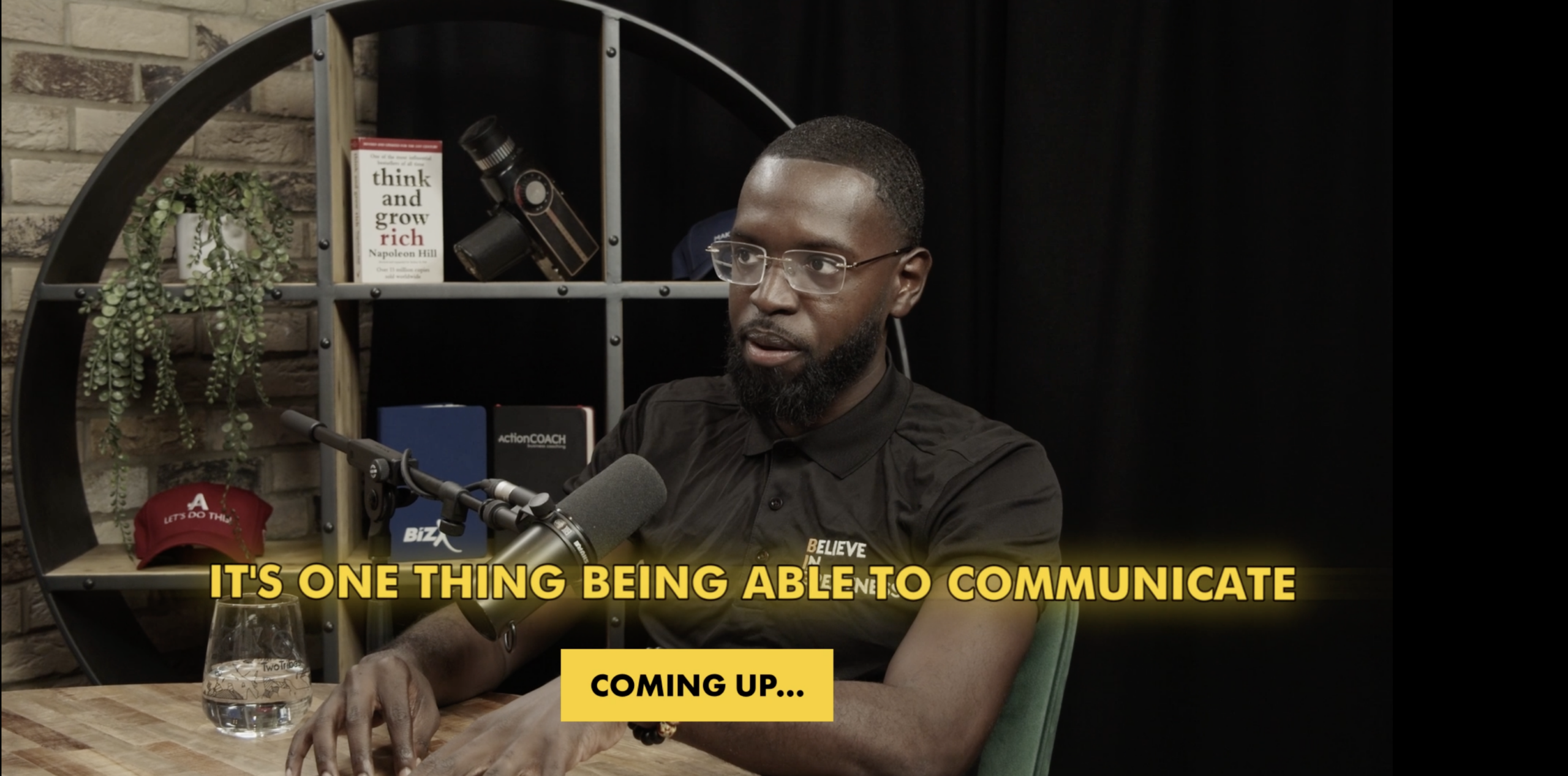
That’s the uncomfortable opener Frederick Afrifa hands us in this week’s ActionCOACH Podcast. He’d know. Frederick was a finalist on The Apprentice, he now trains Fortune 500 executives on communication, and before all of that he was a 10.3-second 100-metre sprinter. He’s spent most of his life learning how to perform under pressure.
So when he says most owners are kidding themselves about how well they communicate, it’s worth a pause.
Here’s what’s actually happening when your team tunes out, your clients glaze over in a pitch, or your partner stops listening when you start talking shop.
The two traps that wreck high-stakes conversations
Frederick names two psychological phenomena that sabotage almost every owner’s communication when it matters most.
The first is explicit monitoring. This is when you overthink an action that’s normally automatic, until you forget how to do it naturally. It’s why footballers miss penalties in the World Cup that they’d score nine times out of ten in training. It’s why presentations that flowed easily in the mirror become awkward, robotic and stilted when you’re in front of the room.
You start watching yourself talk. You become aware of your hands, your voice, the order of your words. The conscious mind hijacks something that should be automatic, and the whole system collapses.
The second is distraction theory. This is when your attention shifts from the message you’re delivering to the audience’s judgement of you. You stop thinking about what you’re saying and start thinking about what they’re thinking about you. Once that switch flips, you’ve lost.
Frederick learned both of these on a sprint start line. The 100 metres is a brutal teacher because it’s nine seconds long. There’s no room to recover. If your nervous system betrays you in the first half a second, the race is over.
The same dynamics that wreck a 100m wreck a sales pitch, a difficult team conversation, an investor presentation, or the conversation you’ve been avoiding with your CFO about pricing.
Why mirror practice is worthless
If you’ve ever been told ‘go and practise in front of a mirror’, Frederick has news for you. It doesn’t work.
Here’s why. The mirror takes you out of pressure. You’re alone. There’s no judgement. There’s no audience. So you’re rehearsing in a state your brain will never be in when it actually matters.
Athletes don’t do this. What they do is called race simulation. They put themselves into an environment that mimics the actual pressure as closely as possible, over and over again, until the nervous system stops firing the panic response.
For business owners, that means: you don’t get better at difficult conversations by rehearsing alone in your office. You get better by HAVING THEM. Lots of them. Small ones first. Bigger ones over time. With your nervous system slowly learning that the actual stakes aren’t life-or-death, and you can survive the discomfort.
Frederick reports that his most intense version of this takes nervous public speakers and transforms them into confident communicators in around 12 hours of training. The mechanism is simple. Forced exposure to the pressure, repeated, with reflection.
The bigger shift: listening is more powerful than speaking
This is the bit that should change how you run every meeting.
We tend to think communication is about how well we speak. Frederick argues it’s actually about how well we listen. He references a Chinese philosophy that defines real listening as listening with three things at once: your eyes, your heart, and your ears.
- The eyes: watch them, fully, like they’re the only person in the room.
- The heart: care about what they’re saying, not about what you want to say next.
- The ears: hear the words, but also the pauses, the tone, the things they almost said.
When you do that, two things happen. They feel heard, often for the first time that week. And you actually pick up the information you need to respond well, instead of broadcasting prepared talking points at them.
In negotiations, this reduces their resistance. In sales calls, it reveals what they actually want to buy. In leadership conversations, it surfaces problems you didn’t know existed.
The owners who get this become magnetic. The ones who don’t keep wondering why their team won’t open up.
Naming your inner critic
One of Frederick’s most practical tools is what he calls the Brian technique.
Brian is the name he’s given to the negative voice in his head. The one that says ‘you’re going to mess this up, they’re going to think you’re an idiot, why are you even up here’. Frederick used to fight Brian. Now he just acknowledges him.
‘Hi Brian. I see you. Thanks for trying to protect me. I’ve got this.’
That sounds soft. It’s actually a piece of neuroscience. The act of naming an emotion or an inner voice creates separation between you and it. You’re no longer fused with the anxiety. You can observe it, work alongside it, and act despite it.
Try it before your next difficult conversation. Name your version of Brian. Greet him. Then carry on.
Confidence is evidence, not affirmations
Most business books tell you to build confidence by saying affirmations in the mirror.
Frederick disagrees, and he has the data on his side. Confidence is activity-specific. You can be extremely confident speaking on stage to 500 people and absolutely terrified asking your accountant a basic question. Or the other way around.
What builds confidence in any specific activity is evidence. Doing it. Surviving it. Doing it again. Slightly better. Until your nervous system has enough reps to relax.
So if there’s an area of your business communication where you feel under-confident (pricing conversations, hiring conversations, the AGM), you don’t fix it by writing affirmations. You fix it by getting reps. Small ones first. Then bigger.
The Apprentice lesson Frederick wishes he’d learned earlier
There’s one more piece worth knowing, because it’s the lesson that cost Frederick the competition: energy management.
He’s introverted. He needed time alone to recover and make good decisions. But on The Apprentice, he was afraid of being judged for going off on his own, so he stayed in the group. Constantly. He drained his decision-making capacity. By the time the big choices came, he didn’t have the bandwidth to make them well.
That lesson applies directly to business owners who try to be everything to everyone. Your decision-making is a tank that empties through the day. If you don’t refill it, you’ll be making your most important calls on fumes.
Protect your alone time. Use it. Even if you’re worried what people will think.
What this means for you this week
If you’ve read this far, you probably recognise yourself in at least one of these patterns.
Pick one conversation you’ve been avoiding because you’ve been telling yourself you ‘don’t know what to say’. You do know what to say. You just don’t want to feel the discomfort of saying it.
Notice when explicit monitoring kicks in. Notice when distraction theory hijacks your attention away from the message and onto the judgement. Catch yourself. Refocus on the person in front of you. Listen with eyes, heart, and ears.
And while you’re at it, name your Brian. Greet him. Carry on anyway.
It might be the most important conversation you have this quarter.
Frederick Afrifa is the guest on the ActionCOACH Podcast.You can listen here:
🎵 Spotify: https://open.spotify.com/episode/6YeFT5vzmRWDCK10lUP4iA?si=edKJU-0oTHmDa8OYdq3mJg
🎙️ Apple: https://podcasts.apple.com/gb/podcast/the-actioncoach-podcast/id1683102859?i=1000739667246
Want a 5-minute honest read on which conversations in your business are leaking value because of the pressure gap? Take the Score Card Quiz.