Is there a project on your list right now that you’ve been telling yourself you’ll “finish next week” — and have been saying that for months?
The website refresh. The pricing review. The conversation with the supplier you should have had in February. The new hire you’ve been “about to write up.”
If three or four came to mind, you’re in good company. Most owners I work with carry between four and six “almost there” projects at any one time. They’re not lazy. They’ve got more good ideas than time to ship them. And they’ve slowly stopped trusting themselves to finish.
That’s not a willpower problem. It’s an operating system problem.
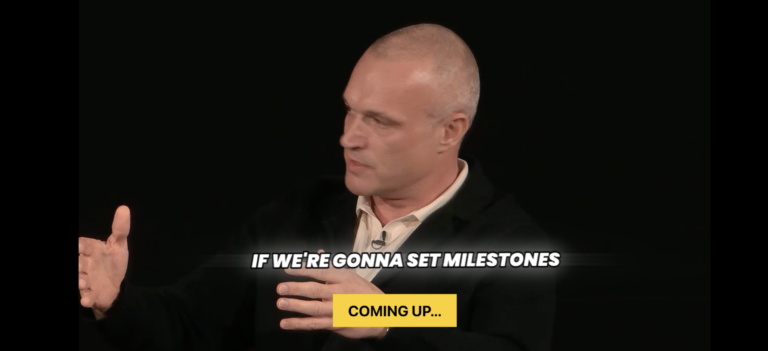
This week’s podcast guest, Jamie Waller, fixed his version of it. And what he uses is the simplest operating system I’ve come across in twenty years of coaching business owners.
It has two colours: green and red.
Before I show you how it works, you need to know a little about Jamie. Because the system only makes sense once you know what it’s been forged out of.
Jamie walked out of his first GCSE exam at sixteen years old, crying. He had written his name on the desk so he wouldn’t forget which paper was his. The invigilator accused him of cheating. He walked out, walked the four miles home to Bethnal Green, and told his mum what had happened.
Her response changed his life. ‘If you can get a job before your next exam day, you don’t have to go back to school.’
Three days later he had a job carrying bricks on a building site. He never sat another exam.
Jamie has since built and exited three businesses. The largest sold for around £70 million. He spent three and a half years as Chair of The King’s Trust Enterprise Network. He counts Richard Branson as a friend. He’s on Branson’s astronaut team.
What’s interesting about his story is not the rags-to-riches arc. You’ve heard those before. What’s interesting is the discipline that runs underneath everything he now does.
The Gantt chart that runs his life
Jamie keeps a Gantt chart for every business he runs. That’s standard. Most CEOs do.
What’s not standard is that Jamie also keeps a Gantt chart for his marriage. One for his fitness. One for his giving and charity work. One for who he wants to be as a father to his daughters.
Every Friday, he reviews all of them.
And here’s the move. None of them have an amber column. Tasks are green (delivered) or red (failed). There is no orange.
‘My Gantt charts don’t have green, orange and red,’ he told me on the podcast. ‘They have green and red. So if red’s not acceptable, guess what? You’ve got to come and you’ve got to deliver.’
That sounds harsh. Read it again. It’s the opposite. Orange is what protects mediocrity. Orange is what lets you tell yourself ‘we’re nearly there’ for six months while a project that should have taken six weeks slowly bleeds you dry. Orange is the safe space where good intentions go to die.
Green and red is uncomfortable. But it’s also clean. You know exactly what’s working. You know exactly what’s not. There’s nowhere to hide. And when there’s nowhere to hide, decisions get made faster.
Why my business projects never get finished — and yours don’t either
Most business owners I coach live almost entirely in orange.
‘We’ve made progress on the new pricing structure.’
‘The website’s nearly there.’
‘The team is working on the recruitment process.’
‘I’ll have the figures by end of next week.’
None of that is green. None of it is red. All of it is amber. All of it is comfort.
If you’ve ever quietly wondered why my business projects never get finished, that’s your answer. Orange is acceptable, so nothing ever has to actually finish. Orange feels like progress, so you can keep telling yourself the project is alive when it has been quietly dead for two months.
I asked a client last month to list his top five priorities for the quarter and tell me, honestly, what colour each one was. He couldn’t say green or red about any of them. Everything was a version of ‘underway’ or ‘in motion’ or ‘I’m getting to it.’
He’d been ‘getting to’ the most important one for nine months.
That is orange. And orange is what’s between him and his next £100k of revenue.
Why discipline beats talent
Jamie isn’t smarter than most of his competitors. By his own admission, he is dyslexic, colour-blind, has ADHD, and left school with no qualifications. What he has is discipline. Specifically, the discipline that comes from refusing to live in the comfortable middle.
He sleeps four and a half hours a night. Not because he’s bragging about it. Because he says it’s his competitive advantage. ‘I just outwork my competitors. I’m thinking about them for longer than they’re thinking about me.’
He walks ten thousand steps a day. No podcasts. No audio. No music. He uses the walking time purely to think. Most owners I work with haven’t had ninety undistracted minutes of thinking time in the last quarter, let alone the last day.
He defined his three personal values in one short phrase. ‘Live a life with energy, passion, and compassion.’ Three words. Every Friday he asks himself which colour he’s been on each of them. Green or red. Never orange.
None of this is glamorous. None of it is the ‘morning routine of CEOs’ content you scroll past on LinkedIn. It is small, repeated, ruthless decisions about what gets coloured green and what doesn’t.
The cameras-off moment
On his fourth day as CEO of the trust-led services business he now runs, Jamie hosted an all-hands Teams call. Thirty-six remote staff. Six of them had their cameras on.
Most new CEOs would have ignored it. Jamie waited until any other business at the end of the call and named it, calmly. ‘That is unacceptable. That won’t happen again.’
Why does this matter? Because his business sells trust. Every decision the business makes either reinforces that brand or undermines it. If staff can’t be bothered to turn their cameras on for the new CEO on his fourth day, what message does that send to clients about how they show up?
Green or red. Cameras on, or cameras off. There’s no orange version of ‘I had my camera on but you couldn’t really see me.’
Pie and mash, not the Bulgari
The day Jamie closed his biggest exit, his wife wanted to celebrate at the Bulgari Hotel spa.
Jamie said no. He drove her back to Bethnal Green, where he grew up. They bought pie and mash for four pounds. They ate it on the pavement. He still has the receipt.
That isn’t frugality. It’s identity. Jamie knows exactly who he is. He knows where he came from. He has no interest in becoming someone he doesn’t recognise just because the bank balance changed.
The owners who scale and stay sane are the ones who never lose touch with that. The ones who don’t, you can spot them at the Bulgari, ordering things they don’t actually want, with people they don’t actually like.
What this looks like for you this week
You don’t have to run your marriage off a Gantt chart to use Jamie’s framework. You just need to be brutally honest about one thing.
Pick the three biggest commitments on your plate right now. Could be the new offer launch. The team hire. The pricing change. The difficult conversation with the underperformer. The financial system upgrade.
Write each one down.
Next to each one, write either G or R.
If your hand reaches for O, stop. There is no O.
If the honest answer is R, you have two choices. Reset the deadline and properly commit. Or kill it. Pick one.
That single act will give you more momentum in your business this week than any new strategy, any new hire, or any new pricing change.
Because the truth about why my business projects never get finished isn’t usually a strategy problem. It’s that we tolerate orange. The £70m businesses don’t get built on better ideas. They get built on the discipline to call things by their proper colour.
(If you want help mapping out which of your projects are quietly dying in orange, my Upgrade Audit walks you through exactly that — in one diagnostic conversation.)
Green or red.
Never orange.
Jamie Waller is the guest on this week’s ActionCOACH Podcast.
Want a 5-minute honest read on where your business operating discipline is leaking? Take the Score Card Quiz.